
Which ERP Is Right for Your Business?
For many businesses, Sage is the software that got them where they are today. It helped manage accounting, streamline operations, and support growth through the early stages of the business.
But growth has a way of changing what businesses need from their ERP.
As operations become more complex, many organizations discover they're adding third-party applications, relying on spreadsheets for reporting, or considering upgrades to another Sage product just to keep pace. At that point, the question isn't simply which version of Sage should we move to? It's whether it's time to invest in a modern cloud ERP built to support the next stage of growth. That's where NetSuite enters the conversation.
Rather than moving from one Sage product to another, many growing businesses choose NetSuite to unify financials, inventory, CRM, manufacturing, ecommerce, and reporting in a single cloud platform designed to scale as they grow. In this guide, we'll explore Sage's most popular software solutions, explain where each one fits, and compare them to NetSuite to help you determine which platform is best positioned to support your business long-term.
Updated: August 4th, 2026
Understanding the Sage Product Lineup
Sage is one of the world's leading providers of accounting, payroll, financial management, and enterprise resource planning (ERP) software. Founded in 1981, Sage serves millions of businesses worldwide with solutions designed for organizations ranging from small businesses to large enterprises.
Unlike NetSuite, which offers a unified cloud ERP platform, Sage's product portfolio consists of several separate software solutions. Each product targets a different market, offers different functionality, and follows its own development roadmap. Because of this, businesses often find themselves asking questions like:
• Which Sage product do I actually have?
• What's the difference between Sage 100 and Sage X3?
• Is Sage Intacct the same as Sage ERP?
• Which Sage solution is best for growing businesses?
Common Sage Customer Complaints
- Not 100% cloud or SaaS
- Third-parties are your only option for eCommerce tools
- No unified ERP platform – not a one stop shop
- No on-demand reporting options
- No customer, vendor, or employee portals
- Users don’t have easy-to-use personalized dashboards
- Customizations are hard as coding is complicated and expensive
NetSuite vs. Sage at a Glance
| Sage Product | Best For | Typical Business Size |
|---|---|---|
| Sage 50 | Small business accounting | Small Businesses |
| Sage 100 | Growing distributors and manufacturers | Small to Mid-Market |
| Sage 300 | Multi-location and international organizations | Mid-Market |
| Sage X3 | Manufacturers, distributors, global organizations | Mid-Market to Enterprise |
| Sage Intacct | Cloud financial management | Growing Mid-Market |
Sage 50
Sage 50 is designed for small businesses that need more robust accounting functionality than entry-level bookkeeping software.
Its core capabilities include:
- General ledger
- Accounts payable and receivable
- Basic inventory
- Payroll options
- Financial reporting
For many organizations, Sage 50 is an excellent place to start. However, as businesses grow, many begin looking for stronger reporting, automation, inventory management, and integration capabilities.
Businesses that outgrow Sage 50 often need much more than accounting software. NetSuite provides a complete cloud ERP platform that combines accounting, CRM, inventory management, purchasing, sales, ecommerce, reporting, and business intelligence in one system. Instead of adding separate software as your company grows, NetSuite scales alongside your business.
NETSUITE VS SAGE 50 COMPARISON
Business Size
- NetSuite: Built for growing businesses requiring a scalable ERP. Built for every business size.
- Sage 50: Designed for small businesses needing basic accounting functionality.
Functionality
- NetSuite: Full ERP covering accounting, CRM, inventory, projects, reporting, and automation.
- Sage 50: Focuses primarily on bookkeeping, invoicing, expenses, and basic financial management.
Growth Potential
- NetSuite: Supports businesses as complexity increases.
- Sage 50: Businesses often outgrow the platform as they need more advanced operational capabilities.
Read More: Top 14 Competitors for ERP Buyers in 2026
Sage 100
Sage 100 is one of Sage's most widely adopted ERP systems for small and midsize businesses. It extends beyond accounting by adding inventory management, purchasing, manufacturing, distribution, customer management, and business reporting.
For many companies, Sage 100 represents an important step beyond basic accounting software. However, organizations often encounter challenges as they expand, particularly when managing multiple entities, remote teams, ecommerce operations, or advanced reporting requirements.
NetSuite was built as a cloud-native ERP from the ground up. Rather than relying on multiple third-party applications or disconnected databases, NetSuite provides one platform for finance, inventory, CRM, ecommerce, warehouse management, manufacturing, and reporting. Businesses gain complete visibility across departments while reducing manual processes and IT complexity.
NETSUITE VS SAGE 100 COMPARISON
Accounting / Financial Management
- NetSuite: Cloud-native ERP with real-time financial visibility across departments, subsidiaries, and locations.
- Sage 100: Traditionally designed for small to mid-sized businesses with core accounting, distribution, and manufacturing capabilities. Often requires add-ons for expanded functionality.
Cloud Architecture
- NetSuite: Built as a true cloud ERP with automatic upgrades, a single database, and access anywhere.
- Sage 100: Historically an on-premise solution. Cloud hosting options exist but typically involve hosted environments rather than a native cloud ERP architecture.
Scalability
- NetSuite: Designed to support organizations as they grow from one entity to global operations.
- Sage 100: Better suited for smaller organizations with simpler operational needs.
Reporting & Dashboards
- NetSuite: Real-time dashboards, KPIs, saved searches, and analytics included.
- Sage 100: Reporting is available but often requires customization, third-party tools, or additional solutions for advanced analytics.
Learn More:
NetSuite vs Sage 100: A Guide for Distributors
Sage 100 to NetSuite Migration Checklist for a Successful Go Live
How to Switch from Sage 100 to NetSuite
Sage 300
Sage 300 is designed for organizations operating across multiple companies, currencies, and locations. It offers strong financial management capabilities along with distribution, purchasing, and project accounting. Its flexibility makes it a popular choice for businesses with international operations.
While Sage 300 handles complex accounting well, many businesses still rely on additional software for CRM, ecommerce, reporting, and customer management. NetSuite unifies these business functions into a single cloud platform, helping organizations eliminate duplicate data, improve collaboration, and gain real-time insight across every department.
NETSUITE VS SAGE 300 COMPARISON
Global Financial Management
• NetSuite: Designed for multinational organizations with native multi-subsidiary, multi-currency, multi-language, tax, and consolidation capabilities.
• Sage 300: Supports multiple currencies and entities but typically requires additional configuration and third-party solutions for more complex global operations.
ERP Capabilities
• NetSuite: Unified ERP platform including financials, CRM, inventory, projects, ecommerce, and analytics.
• Sage 300: Primarily focused on accounting and financial management with industry-specific add-ons.
Cloud Experience
• NetSuite: Native cloud ERP.
• Sage 300: Primarily known as a legacy accounting platform with cloud hosting options.
Learn More: NetSuite vs. Sage 300
Sage X3
Sage X3 is Sage's flagship ERP solution for larger manufacturers, distributors, and organizations with more sophisticated operational requirements.
Key capabilities include:
- Manufacturing
- Supply chain management
- Production planning
- Inventory optimization
- Financial management
- Purchasing
- Sales management
Sage X3 offers extensive functionality for organizations with complex operational needs. Both Sage X3 and NetSuite support manufacturers and distributors, but NetSuite delivers these capabilities through a modern cloud architecture with built-in CRM, ecommerce, AI-powered reporting, and automatic updates. Instead of maintaining multiple systems or planning complex upgrades, businesses can manage their entire operation through one scalable cloud platform.
NETSUITE VS SAGE X3 COMPARISON
Target Market
- NetSuite: Mid-market to enterprise organizations seeking a flexible cloud ERP.
- Sage X3: Designed for larger organizations with complex manufacturing, distribution, and operational requirements.
Cloud ERP
- NetSuite: Born in the cloud with automatic upgrades and a unified platform.
- Sage X3: Can be deployed in the cloud but maintains a traditional ERP architecture.
Manufacturing
- NetSuite: Provides manufacturing capabilities through native modules and SuiteApps.
- Sage X3: Strong manufacturing and supply chain capabilities, particularly for process manufacturing.
Customization
- NetSuite: SuiteCloud platform allows custom workflows, scripts, integrations, and applications.
- Sage X3: Highly configurable but often requires specialized development resources.
Learn More: NetSuite vs. Sage X3
Sage Intacct
Sage Intacct is a cloud financial management solution focused primarily on accounting and finance.
It's strengths include:
- Financial consolidation
- Revenue recognition
- Multi-entity accounting
- Dashboards
- Budgeting
- Financial reporting
Many organizations choose Sage Intacct for its accounting capabilities.
Unlike Sage Intacct, NetSuite extends beyond financial management. Businesses gain a complete ERP platform that includes CRM, inventory management, procurement, order management, manufacturing, warehouse management, ecommerce, professional services automation, and AI-powered business intelligence—all within a single application. This reduces integration costs while providing one source of truth across the organization.
NETSUITE VS SAGE INTACCT COMPARISON
Accounting / Financial Management
- NetSuite: Full ERP platform combining financials, CRM, inventory, order management, projects, and reporting in one unified system.
- Intacct: Primarily a cloud financial management solution focused on accounting, reporting, and compliance.
Multi-Entity / Global Operations
- NetSuite: Native multi-subsidiary management, intercompany transactions, global tax, currencies, and consolidated reporting.
- Intacct: Designed primarily for U.S.-based organizations. Global capabilities often require additional modules and configurations.
Project Management
- NetSuite: Built-in project accounting and PSA capabilities for planning, resource management, time tracking, billing, and profitability.
- Intacct: Offers project accounting capabilities but relies on additional solutions for deeper project management functionality.
Learn More:
NetSuite vs. Sage Intacct
6 Reasons why Businesses choose NetSuite vs Sage Intacct
NetSuite vs Sage Intacct: Which one is right for your nonprofit
What are the benefits of NetSuite?
- Streamline and automate business processes
- Cut financial close times and quote-to-cash cycle times by up to 50%
- Drive down invoicing costs by up to 75%
- Run your business anytime, anywhere with real-time visibility across the organization
- Eliminate IT hassles, and reduce total cost of ownership by up to 50%
VISIBILITY
Improve business performance with real-time metrics and role-based dashboards
CLOSE
Accelerate the financial close while maintaining compliance with accounting standards.
BUSINESS PROCESSES
Eliminate errors with seamless integration between financials, CRM and ecommerce.
REPORT INFORMATION
Drill down into the underlying details to understand the impact to your business.
Growing Companies Eventually Reach a Crossroads. Transform your business with NetSuite.
NetSuite has achieved many awards for being the leader in ERP, helping some of the most innovative, fast-growing companies in the business world today! NetSuite continues to improve and strengthen its software with every update and is the #1 AI cloud ERP business management suite on the market.
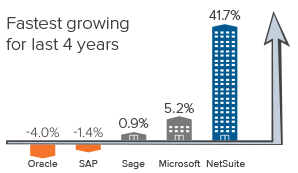
More than 44,000 customers run NetSuite—the world’s # 1 cloud business management suite, and the world’s fastest-growing financial management solution for four years running. |
 |
Protelo and NetSuite Partnership
Providing unparalleled service as a top-tier NetSuite Solutions Provider, Protelo implements business technology solutions and services that drive efficiency and solve the challenges modern businesses face. The Protelo team of technology experts have assisted hundreds of small, midmarket and enterprise companies across diverse industries and verticals in achieving their business goals.
Through tailored business software development, implementation, services and management, we have helped our clients streamline business processes and the flow of critical information. From the planning stages to managed services, Protelo is an end-to-end provider of business software expertise.
Request More Information
Free NetSuite Product Tour
Learn more about the worlds #1 Cloud ERP. Protelo’s award-winning NetSuite experts are here for your business.
LiveChat our team, submit a form or call us today.
