
NetSuite Financial Management Software for Growing Businesses
Cloud-Based ERP Accounting & Financial Management
NetSuite offers a powerful cloud-based financial management software solution that helps businesses manage their financial operations with greater efficiency, visibility, and control. It brings together essential financial capabilities including accounting, financial reporting, budgeting, forecasting, billing, revenue management, and analytics, while connecting financial data with the rest of the business.
As organizations grow, managing these processes across disconnected systems can make it harder to maintain accurate data, produce timely reports, and understand overall business performance. NetSuite provides a centralized financial platform that can support increasingly complex operations while giving finance and leadership teams the information they need to manage the business.v
💡 NetSuite Financial Management: Key Takeaways
NetSuite is a cloud-based financial management and ERP platform for growing businesses that need more than traditional accounting software can provide. It brings accounting, reporting, billing, revenue management, budgeting, forecasting, and other financial processes together with the rest of the business, giving finance and leadership teams greater visibility, automation, control, and scalability.
In short:
- Why NetSuite? Automate financial processes, improve reporting and visibility, accelerate close, and support business growth.
- Who is it for? Businesses outgrowing QuickBooks or other accounting systems, especially those with increasing financial or operational complexity.
- What are the alternatives? Traditional accounting software may work for simpler businesses; NetSuite becomes more compelling as reporting, automation, multi-entity, and integration needs grow.
- What should you consider? Features, scalability, implementation requirements, integrations, data migration, costs, and your long-term business needs all matter.
- What about implementation? Choosing the right NetSuite partner is just as important as choosing the platform.
- What’s next? Evaluate whether NetSuite fits your business and find an experienced partner to help you implement it successfully.
Why Businesses Choose NetSuite for Financial Management
For many organizations, the decision to move to NetSuite starts with a simple problem: the current accounting system is no longer keeping up with the business.
As transaction volumes increase, new entities are added, reporting becomes more complex, or finance teams become increasingly dependent on spreadsheets and manual processes, the limitations of traditional accounting software become harder to ignore.
NetSuite brings financial management and core business processes together in one cloud ERP platform, giving finance and leadership teams a more complete view of the business.
Built for More Connected, Efficient Financial Operations
NetSuite can help organizations:
- Accelerate order-to-cash by connecting sales, fulfillment, billing, accounts receivable, and payment processes.
- Shorten the financial close by automating workflows and reducing manual reconciliation and data gathering.
- Improve cash visibility with real-time access to financial information and reporting.
- Strengthen decision-making with personalized dashboards, KPIs, and current business data.
- Give finance teams greater flexibility with secure, anytime access to financial information in the cloud.
- Support growth with a scalable platform that can accommodate increasing financial and operational complexity.
These capabilities are part of a broader ERP platform, allowing financial information to connect with operations, sales, inventory, customer management, and other critical business processes.
See NetSuite in action: Explore the NetSuite Financial Management Product Tour →
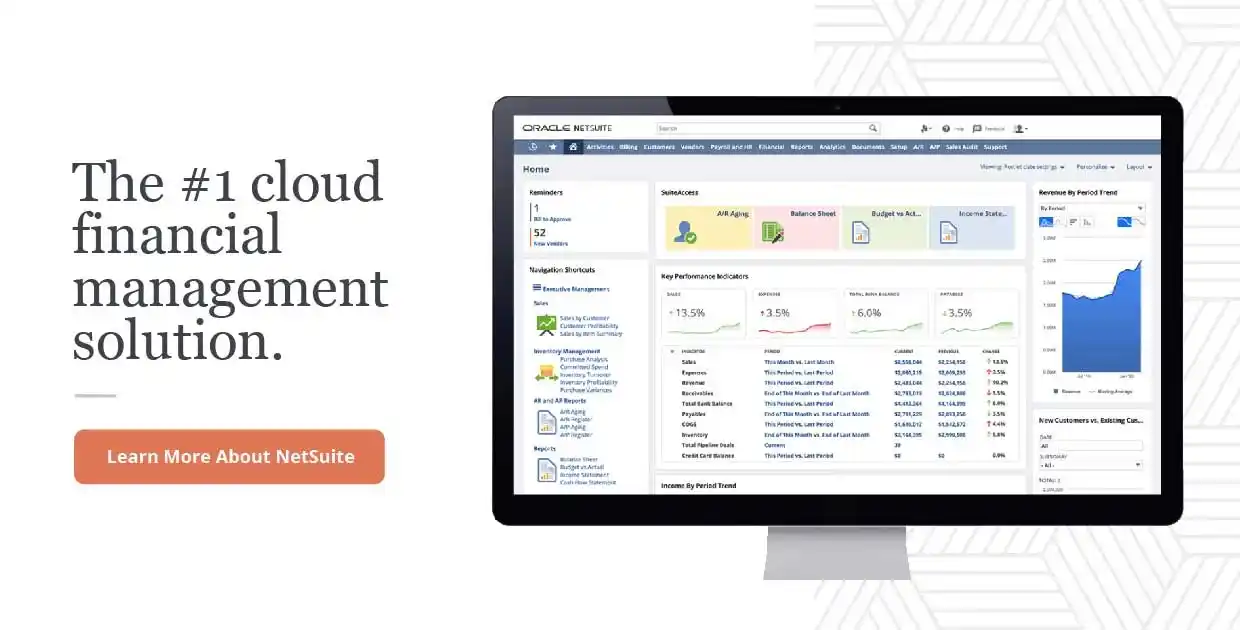
Businesses that have the right financial management tools in place are better positioned to grow and make data-informed decisions, no matter what comes their way. With the unpredictability of the economy, businesses are constantly being forced to adapt to stay afloat. NetSuite’s financial management suite continues to rank at the top of Gartner’s Magic Quadrant amongst competitors.

5 Signs You're Outgrowing Your Accounting Software:
The need for a new financial management system isn't always obvious. Often, the warning signs show up in the day-to-day work of the finance team.
Your current system may be holding your business back if:
1. Financial reporting is too manual
Your team spends significant time exporting data, manipulating spreadsheets, or combining information from multiple systems to produce regular reports.
2. Your financial close takes too long
Month-end or year-end close requires extensive manual reconciliation, journal entries, approvals, or data gathering.
3. You lack real-time financial visibility
Leadership has to wait for reports or rely on outdated information to understand cash flow, profitability, or business performance.
4. Your processes lack the controls you need
Journal entries, approvals, reconciliations, and other financial processes rely on manual oversight or workarounds rather than standardized workflows and controls.
5. Your business has become more complex than your accounting system
Multiple entities, locations, currencies, business units, products, or revenue streams make your existing chart of accounts and reporting structure increasingly difficult to manage.
If several of these sound familiar, the issue may no longer be your processes alone. Your financial system may simply have reached its limits.
NetSuite Financial Management Features
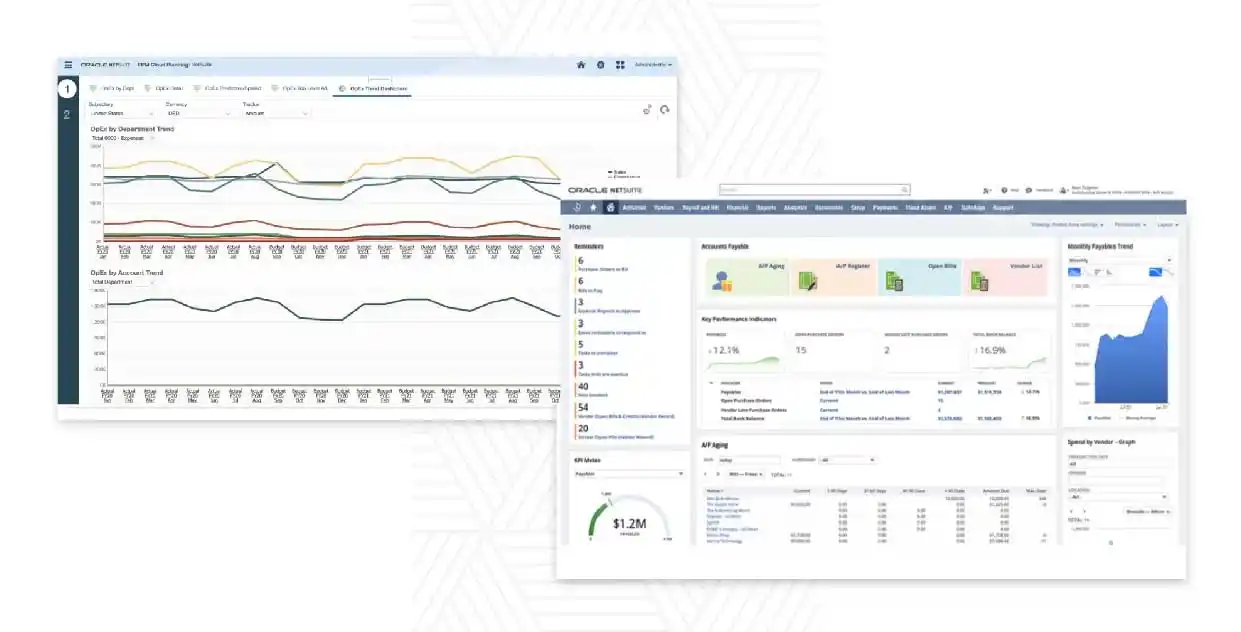
NetSuite provides a broad set of financial management capabilities within a single cloud ERP platform.
General Ledger & Accounting
NetSuite's general ledger provides a centralized foundation for managing financial transactions and reporting. Organizations can configure accounting structures around their business using departments, classes, locations, subsidiaries, and other financial segments.
Capabilities include:
- General ledger and journal management
- Custom financial segments
- Multiple accounting books
- Period close management
- Automated journal entries
- Role-based permissions and approvals
- Audit trails
- Consolidated financial reporting
The result is a more flexible financial structure without requiring finance teams to rely on excessive manual entries or separate systems.
Accounts Payable
NetSuite helps automate accounts payable processes from invoice management through payment.
Key capabilities include:
- Vendor bill management
- Purchase order and receipt matching
- Approval workflows
- Payment scheduling
- Electronic payments
- Vendor management
- 1099 reporting
- AP reporting and analytics
By connecting purchasing, receiving, accounts payable, and payment processes, finance teams can reduce manual work while gaining greater visibility into upcoming obligations and cash requirements.
Accounts Receivable
NetSuite provides centralized management of customer receivables, helping finance teams monitor invoices, payments, collections, and customer credit.
Capabilities include:
- Customer invoicing
- Payment tracking
- Collections management
- Customer credit management
- Automated updates
- AR reporting
- Cash flow visibility
With receivables connected to the broader financial system, teams can better understand current and projected cash positions and identify outstanding balances more quickly.
Billing & Revenue Management
For businesses with more complex billing or revenue requirements, NetSuite can connect sales, contracts, billing, and financial processes within the same system.
This can help organizations automate billing processes, improve accuracy, and maintain better visibility into revenue throughout the customer lifecycle.
Financial Reporting & Analytics
NetSuite provides real-time reporting and analytics across financial and operational data.
Finance teams can create:
- Financial statements
- Management reports
- KPIs
- Dashboards
- Saved searches and reports
- Custom financial reports
- Consolidated reports
Instead of waiting for data to be manually compiled, finance and executive teams can work from a shared source of financial information.
Budgeting, Planning & Forecasting
NetSuite can support budgeting, planning, and forecasting processes by bringing financial and operational information into the planning process.
This gives finance teams greater visibility into expected performance and helps leadership evaluate scenarios, identify trends, and plan for future growth.
Multi-Entity Financial Management
Businesses operating across multiple subsidiaries, locations, or countries can manage financial information within a centralized system.
NetSuite supports:
- Multi-subsidiary accounting
- Consolidation
- Multiple currencies
- Intercompany transactions
- Global financial reporting
- Local and statutory requirements
This can significantly reduce the manual consolidation work required when financial information is maintained across separate systems.
Cash Management & Reconciliation
- General Ledger & Accounting
- Accounts Payable
- Accounts Receivable
- Billing & Revenue Management
- Financial Reporting & Analytics
- Budgeting, Planning & Forecasting
- Multi-Entity Financial Management
Customer Success Story:
How Trinity Solar Improved Financial Visibility With NetSuite
When Trinity Solar outgrew QuickBooks Enterprise, one of the biggest challenges was the amount of time required to close the books. Its financial close could take up to 30 days.
Protelo helped Trinity Solar implement NetSuite and build a more connected financial environment. The company reduced its close cycle to 10–12 days and gained clearer visibility into gross margin, profitability, job costing, AP, billing, and operational data.


NetSuite Financial Management Benefits
NetSuite's value isn't simply the number of financial features it provides. The larger benefit is bringing financial processes and business data together so organizations can operate with greater visibility and control.
1. Reduce Manual Work:
Automate repetitive accounting and financial processes so teams spend less time entering, reconciling, and moving data between systems.
2.Close the Books Faster:
Connect financial data and workflows to reduce the manual work involved in month-end and year-end close.
3. Improve Financial Visibility:
Give finance and executive teams access to current financial and operational information through centralized reporting and dashboards.
4. Strengthen Financial Controls:
Use permissions, approval workflows, standardized processes, and audit trails to establish stronger financial controls.
5. Improve Decision-Making:
Give leadership access to timely financial information and business performance data instead of relying on outdated or manually compiled reports.
6. Build for Growth:
Support additional transactions, entities, locations, currencies, and business processes without continually adding disconnected systems.
NetSuite vs. Traditional Accounting Software
Traditional accounting software can work well for smaller or less complex organizations. The challenge comes when the business begins to outgrow what a standalone financial system can reasonably support.
| Business Need | Traditional Accounting Software | NetSuite |
|---|---|---|
| Core Accounting |
✓ |
✓ |
| Real-Time Financial Visibility | Limited | ✓ |
| Automated Financial Workflows | Limited | ✓ |
| Multi-Entity Management | Often Limited | ✓ |
| Consolidated Reporting | Often Manual | ✓ |
| Financial + Operational Data | Often Seperate | Connected |
| Advanced Reporting | Limited | ✓ |
| Scalability | Varies | ✓ |
| Global Financial Management | Limited | ✓ |
The difference isn't simply that NetSuite has more features. NetSuite is designed to connect financial management with the broader business, creating a single environment for financial and operational information.
NetSuite vs QuickBooks
QuickBooks can be an effective accounting solution for smaller businesses. As organizations grow, however, they may encounter limitations around reporting, automation, multi-entity management, integrations, and operational visibility.
NetSuite provides a broader ERP platform that can connect financial management with inventory, order management, CRM, procurement, reporting, and other business functions.
The better question isn't simply whether NetSuite is "better" than QuickBooks. It's whether your business has reached the point where its current accounting system is limiting visibility, automation, control, or growth.
Read: Outgrowing QuickBooks? Compare QuickBooks Accounting to Oracle NetSuite
When Should You Consider NetSuite?
There is no single revenue, employee, or transaction threshold that determines when a business should move to NetSuite.
The stronger indicators are business complexity and the limitations of your current system.
Consider evaluating NetSuite if your business is:
- Growing rapidly
- Adding subsidiaries or locations
- Expanding internationally
- Acquiring other businesses
- Managing increasingly complex billing or revenue requirements
- Spending too much time preparing financial reports
- Relying heavily on spreadsheets
- Struggling with a slow financial close
- Managing multiple disconnected systems
- Looking for better executive visibility
- Outgrowing the capabilities of its current accounting software
The right time to evaluate an ERP is often before system limitations become a significant constraint on growth.
What Should You Consider Before Choosing NetSuite?
NetSuite is a significant technology investment, so evaluating the platform means looking beyond the feature list.
Consider:
1. Business requirements:
Does NetSuite address the financial and operational processes your organization needs today and expects to need in the future?
2. Scalability:
Can the system support additional entities, locations, users, transactions, and complexity as the business grows?
3. Integrations:
Which systems need to connect with NetSuite, and how will information move between them?
4. Data migration:
What historical and current financial data needs to move into the new system, and how will it be cleansed and validated?
5. Customization:
Where should your business adapt to standard NetSuite functionality, and where is customization genuinely necessary?
6. Total investment:
Consider software licensing alongside implementation, migration, integrations, customization, training, support, and ongoing optimization.
7. Implementation partner:
The partner you choose can have a major impact on implementation quality, timeline, adoption, and long-term success.
What Does a NetSuite Financial Management Implementation Involve?
A successful NetSuite implementation is more than configuring software. The system needs to reflect the organization's financial structure, business processes, reporting requirements, integrations, and long-term objectives.
A typical implementation includes:
- Discovery & Planning
Define business requirements, current-system challenges, goals, scope, and priorities. - Solution Design
Determine how NetSuite should be configured to support financial and operational processes. - Configuration
Configure financial structures, workflows, permissions, dashboards, reporting, and other required functionality. - Data Migration
Clean, map, validate, and migrate the financial and operational data required in the new system. - Integrations & Customization
Connect NetSuite with critical business systems and develop custom functionality where necessary. - Testing & Training
Validate business processes and integrations while preparing users for the new system. - Go-Live & Optimization
Transition to NetSuite, support users through go-live, and continue optimizing the platform as business needs evolve.
Implementation timelines vary based on scope, complexity, integrations, data requirements, customization, and organizational readiness.
Choosing the Right NetSuite Partner
NetSuite provides the technology. Your implementation partner helps determine how effectively that technology works for your business.
When evaluating a NetSuite partner, look for:
- Proven NetSuite implementation experience
- Deep financial management expertise
- Experience with businesses of similar complexity
- Senior, experienced consultants
- A defined implementation methodology
- Data migration and integration capabilities
- Industry-specific knowledge where relevant
- Post-go-live support and optimization
- Measurable customer results and references
The right partner should understand both how NetSuite works and how your business works.
Why Businesses Choose Protelo
Protelo is a certified Oracle NetSuite implementation partner with more than 15 years of experience helping businesses implement, optimize, and support NetSuite.
Our team includes experienced NetSuite consultants and financial professionals who understand the challenges finance and executive teams face when moving from disconnected or outdated systems to a modern ERP.
Protelo supports businesses throughout the NetSuite lifecycle, including:
- NetSuite implementation
- Financial management
- Data migration
- Integrations
- Customization
- NetSuite optimization
- User training
- Ongoing NetSuite support
Our approach is focused on understanding the business first, then configuring NetSuite around its processes, requirements, and goals.
NetSuite Experience Backed by Results
Trinity Solar, a rapidly growing solar energy company with more than $700 million in annual revenue, had outgrown QuickBooks Enterprise and was dealing with fragmented systems and a financial close that could take up to a month. Protelo implemented NetSuite in approximately 90–120 days.
The result: Trinity Solar reduced its financial close from approximately 30 days to 10–12 days.
The implementation also gave leadership greater visibility into the business and established a more scalable financial foundation for continued growth.
Read the Trinity Solar's NetSuite Case Study →
Frequently Asked Questions About NetSuite Financial Management
What is NetSuite financial management?
NetSuite financial management is the financial management functionality within Oracle NetSuite's cloud ERP platform. It supports accounting, financial reporting, billing, revenue management, budgeting, forecasting, financial controls, and other financial processes.
Is NetSuite an accounting system or an ERP?
NetSuite is a cloud ERP platform that includes comprehensive accounting and financial management capabilities. Unlike standalone accounting software, NetSuite connects financial management with operational functions across the business.
What are the main benefits of NetSuite financial management?
Key benefits include greater financial visibility, automated processes, faster financial close, stronger controls, improved reporting, multi-entity capabilities, and a scalable platform for growing businesses.
Is NetSuite good for growing businesses?
NetSuite is designed to support organizations as their financial and operational requirements become more complex. It can support growing transaction volumes, additional entities, locations, currencies, users, and business processes.
Can NetSuite replace QuickBooks?
Yes. NetSuite can replace QuickBooks as a company's core financial system while also providing broader ERP capabilities. The right choice depends on the company's size, complexity, growth plans, and technology requirements.
How long does a NetSuite implementation take?
Implementation timelines vary based on business complexity, scope, integrations, data requirements, customization, and organizational readiness. Focused implementations may take a few months, while more complex projects can require longer.
How much does NetSuite cost?
NetSuite costs vary based on licensing, users, modules, implementation requirements, integrations, customization, and ongoing support. Businesses should evaluate the total investment rather than software licensing alone.
How do I know if NetSuite is right for my business?
Evaluate your current financial processes, system limitations, business complexity, growth plans, reporting requirements, and technology environment. A qualified NetSuite partner can help determine whether NetSuite aligns with your requirements and objectives.
Does Protelo implement NetSuite financial management?
Yes. Protelo provides NetSuite implementation services covering financial management, data migration, integrations, customization, training, optimization, and ongoing support.
Evaluate NetSuite With a Partner You Can Trust
If your current accounting system is making it harder to close the books, understand performance, manage complexity, or support growth, it may be time to evaluate a more connected financial management platform.
Talk to a NetSuite Expert
Discuss your current systems, financial management requirements, and business goals with a NetSuite specialist.
Protelo's NetSuite experts help businesses select, tailor, and implement software to run their organization on one, integrated, cloud-based platform. Have Questions? Would you like a free trial or a demo? To learn more contact our team of NetSuite experts today! We are here to make your business even better.
Receive Updates
On LinkedIn
Request More Information
This site is protected by reCAPTCHA and the Google
Privacy Policy and
Terms of Service apply.
Free NetSuite Product Tour
Learn more about the worlds #1 Cloud ERP. Protelo’s award-winning NetSuite experts are here for your business.
LiveChat our team, submit a form or call us today.
